The TimeKairos Manifesto: 7 Principles of Our Digital Web Atelier
TimeKairos began with a simple idea: ordering a website should not require a leap into the unknown.
A client should not have to pay for an abstract promise and wait several weeks before seeing what they are actually buying.
At the same time, a faster launch should not automatically mean a mass-market template, technical compromises or dependence on a platform the business does not control.
This is why we are building TimeKairos as a digital web atelier: a model positioned between fully bespoke studio development and mass-market website builders.
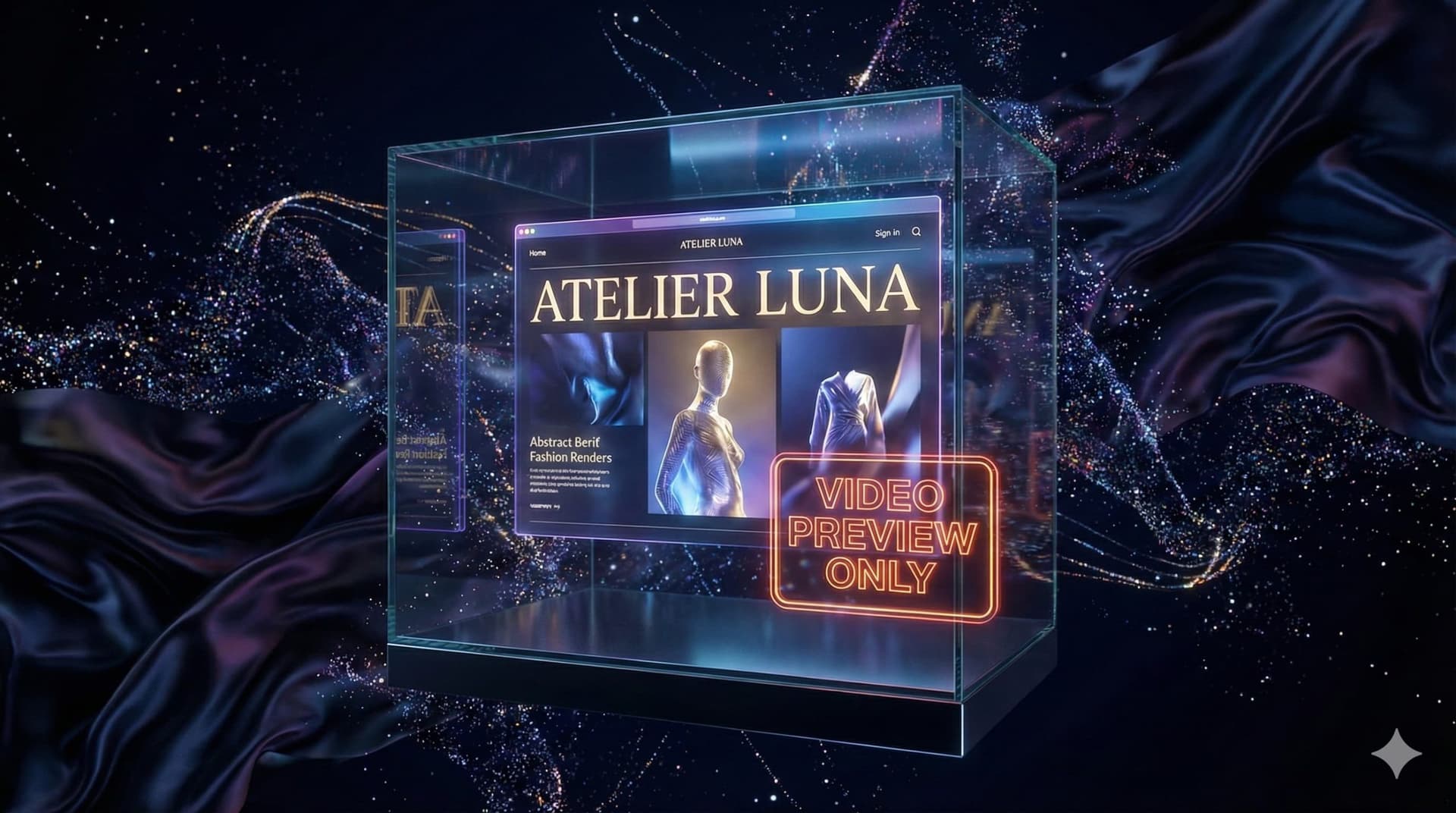
We maintain a collection of original website foundations. A client can see the direction before committing, select an appropriate foundation and then have it adapted to the brand, content, structure and requirements of the business.
This manifesto is not an attempt to claim that our model is right for everyone.
It defines seven principles according to which we want to work.
1. See the direction before making the decision
Traditional web development often begins with presentations, requirements documents and reference websites. The client gradually sees the future product through wireframes, design concepts and finally development. For highly complex and completely bespoke products, that process can be entirely appropriate. But not every business needs to begin from a blank canvas. At TimeKairos, we chose a different starting point. A client can first choose an original design foundation from our catalog, review its presentation and see the underlying experience in action before confirming the project. There is an important distinction: this is not yet the finished website of the client's company. It is a demonstration of the foundation — structure, visual direction, motion and the overall interaction model. Once the project begins, that foundation is adapted to the actual business. Our principle is simple: the client should understand the direction they are buying before the main work begins.2. A proven foundation is not the same as a mass-market template
We do not believe that reusing proven architecture is inherently a disadvantage. There is little value in repeatedly solving the same basic problems from scratch when a team already knows how to solve them well. There is, however, an important difference between a reusable foundation and a mass-market template. A conventional template can be sold to an unlimited number of businesses in almost identical form. Within the TimeKairos model, a foundation is the starting point for individual adaptation. We work with:- company content;
- brand colours and typography;
- page architecture;
- services and products;
- calls to action;
- forms;
- animation;
- required business logic.
3. One selected design, one owner
One of the principles behind the TimeKairos catalog is limited availability of design concepts. Once a particular concept is purchased, it is removed from the catalog and is no longer offered to another client as the same design. For us, this creates a middle ground between two models. The client can select an existing foundation and understand its direction before development begins. At the same time, we do not want the catalog to become a marketplace in which the same page is sold to hundreds of companies. Exclusivity does not mean another website will never use a similar button, grid or navigation pattern. Modern websites share many established UX conventions. The principle is more specific: once a design concept from the catalog has been purchased, that particular concept is no longer available for another purchase.4. Speed should come from preparation, not skipped work
It is easy to make a website quickly by removing research, testing, mobile adaptation and quality control. We want to make the process faster in a different way. Part of the work exists before a client arrives:- the underlying architecture;
- a base design system;
- implemented components;
- responsive behaviour;
- tested technical patterns.
5. Clients should understand what they are paying for
Web-development proposals can easily combine design, code, management, CMS functionality, integrations, maintenance and future changes into one number. Later, the client may discover that an important function was outside the original scope or that they paid for functionality they never needed. We prefer to work around a clearly defined project scope. Before development begins, it should be clear:- which pages are included;
- what adaptation is included;
- which content the client provides;
- which integrations are required;
- what is part of the agreed base scope;
- what would constitute additional custom development.
6. Quality is a process, not a word in a proposal
Any provider can describe its development as “high quality”. We prefer to break quality down into things that can actually be checked. Before launch, different layers of the website are reviewed, including implementation, responsive behaviour, performance, technical SEO foundations, accessibility, forms, links and primary user journeys. We combine automated checks with manual QA. Automation is effective at detecting certain categories of technical issues. But it cannot fully replace a person who opens the site on a smartphone, completes a real user journey and notices that a technically valid interface is simply uncomfortable to use. AI and automation are therefore quality-control tools for us, not substitutes for human responsibility.7. The business should own the result
We believe a client should not remain dependent on a provider solely because that provider originally built the website. After the project is completed, the business receives the source code and relevant access credentials within the agreed implementation. This means the website can later be:- moved to different hosting;
- handed to another qualified developer;
- developed further;
- integrated with other systems;
- modified without mandatory dependence on TimeKairos.
Where does fully custom development fit?
A catalog cannot solve every possible problem. And it should not try to. A business may need:- a complex customer portal;
- a custom configurator;
- a web application;
- a specialized integration;
- unique information architecture;
- a completely original design system.