Back to Journal

Ukraine's Website Language Law in 2026: Real Fines, How It Works, and How to Comply Before You Get a Complaint
Ukraine's Website Language Law in 2026: Real Fines, How It Works, and How to Comply Before You Get a Complaint
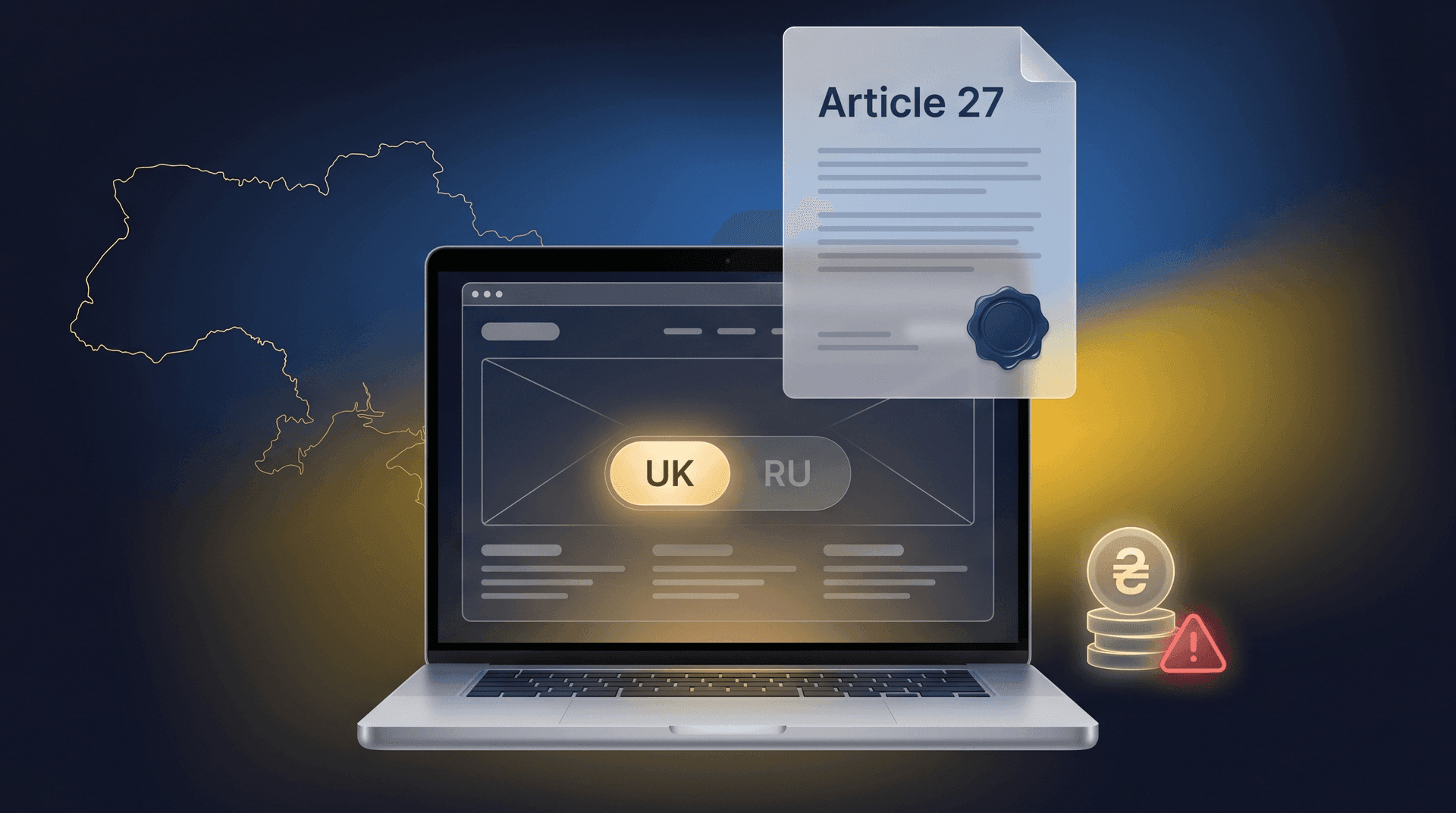
"Our site is in Russian because our clients are Russian-speaking" — a position that was normal in 2019, debatable in 2022, and in 2026 costs up to UAH 11,900 in fines per inspection. With every repeat offense. The law in question is Ukraine's Law No. 2704-VIII "On Ensuring the Functioning of the Ukrainian Language as the State Language." Adopted in April 2019, but the website-specific provision came into force on July 16, 2022. That's four years of practice now, the first real fines, the first court appeals — and a clearly established position from the Language Ombudsman: there are almost no exceptions. Let's break it down without myths or panic. What the law actually requires Article 27 establishes two key requirements for any website:
  1. A Ukrainian-language version is mandatory if your company is registered in Ukraine or if you sell goods/services to Ukraine.
  2. The Ukrainian version must load by default for users with Ukrainian IP addresses. Not "there's a switcher somewhere in the menu" — the landing page itself must be Ukrainian.
Other language versions are allowed — Russian, English, Polish, anything. But the Ukrainian version must be no smaller in scope and no lower in quality than any other language version. Not a "short stub of three sentences," but a full website. This applies to everything: landing pages, corporate sites, online stores, mobile apps, official social media pages for business (since 2023), and email communications. Who it applies to (including you) The law works on a territoriality + origin principle. You're under it if at least one of the following is true:
  • Your legal entity/sole proprietorship is registered in Ukraine (even if all clients are abroad)
  • You sell goods or services to Ukraine (even from abroad)
  • You have a Ukrainian domain (.ua, .com.ua, .kyiv.ua, etc.)
  • You advertise your services to a Ukrainian audience through any channel
Exceptions are limited:
  • Media outlet websites — separate Article 25, different rules
  • Personal blogs and non-commercial sites
  • Foreign sites not specifically targeting Ukraine (e.g., a Dutch B2B portal with no Ukrainian version and no shipping here)
"My site is in Russian because I'm from Kharkiv" — not an argument. Regional origin doesn't matter. "We're crypto/SaaS, we're not in Ukraine" — if you accept payments from Ukrainian users or have a Ukrainian audience, you're under the law too. How an inspection and fine actually work The trigger is a complaint. Any user can go to mova-ombudsman.gov.ua, fill out a form: "I visited [your-domain.com], from a Ukrainian IP I was greeted by a Russian version, there's no Ukrainian version / it's shorter / it's machine-translated." Attaches screenshots. The Language Ombudsman then sends you an official warning. You have 30 days to fix the issue without a fine. This is important: the first warning almost always carries no penalty if you respond. If you don't fix it within 30 days, a protocol is filed and goes to court. The fine is UAH 5,100–6,800 (200–300 non-taxable minimums under Article 188-52 of the Administrative Offenses Code). If a second confirmed complaint arrives within a year of the first fine — UAH 8,500–11,900. And so on for each repeat. "Small amount" — true, while there are one or two complaints. But there's a practice of activists filing complaint series against entire categories of sites (dental clinics, law firms, gyms) — one company can rack up multiple consecutive fines for different sections of the site, quickly becoming UAH 50,000–100,000 per year. Real cases from 2024-2025 No names (many cases are still on appeal), but the scale:
  • Major marketplace — series of fines for missing Ukrainian version in the seller dashboard
  • Dental network (10+ cities) — fines for Russian default on branch sites
  • Several major iGaming platforms — fines for game UI in English/Russian only without Ukrainian
  • Major fintech startup — fine for email newsletter in English only
Common thread: all said "but we have a Ukrainian switcher." Not accepted, because the default load was another language. What's typically broken on 80% of sites, in practice Based on our AI X-Ray data (we've audited 800+ sites), typical violations:
  1. Russian default for Ukrainian IPs. Usually a 2019-2021 legacy when "ru" was treated as primary.
  2. Ukrainian version exists, but via Google Translate. The law doesn't recognize this — "proper quality" is required explicitly.
  3. Ukrainian version is shorter than Russian/English. Part of the catalog/blog/FAQ exists only in another language.
  4. Buttons, forms, error messages — in Russian/English. Content translated, UI not.
  5. Email and checkout only in another language. Site is bilingual, but the order confirmation is in Russian.
  6. Business social media in Russian. The law applies to official brand pages on Instagram/Facebook/TikTok if they're commercial.
How to check your site in 5 minutes (free) No lawyer needed:
  1. Open your site through a VPN with a Ukrainian IP (or just from a home connection in Ukraine). What loaded first — Ukrainian or another language? If it's another — that's a violation.
  2. Check every page linked from the main menu. Does a Ukrainian version exist? Is it complete? Is the translation human?
  3. Submit a test form. Did the confirmation email arrive in Ukrainian?
  4. AI X-Ray (timekairos.com.ua/ai-xray) — our free tool that checks for a Ukrainian version, the lang="uk" attribute, hreflang markup, plus ~100 other items (Schema.org, Core Web Vitals, accessibility). One URL — full report.
What to do if everything is "bad" An honest tier-list: Option 1 — machine translation via a WordPress plugin (like WPML+DeepL). Fast, cheap ($50-100), formally a Ukrainian version exists. Risk: the Ombudsman has the right not to recognize this as "proper quality," especially for legal documents, medical services, and finance. Will pass for a pizza-delivery blog. Will not pass for a dental clinic's terms of service. Option 2 — human translation of the existing site. Translator + admin integration. $300-1,500 depending on scope. A working, legal, "we're now properly compliant" option. Option 3 — rebuild the site with Ukrainian as the primary language. Ukrainian as primary, others as additional. If you're planning to refresh the site in the next 1-2 years anyway — it makes sense to do this in one go, both for SEO benefits (Google loves hreflang) and easier maintenance. What NOT to do:
  • "Russian by default, switcher somewhere in the footer" — doesn't count
  • Translating only the homepage — violation
  • Hiding the switcher inside the mobile hamburger menu — formally works, but in practice activists file complaints on this
  • Ignoring email comms — order confirmations and reminders are also under the law
What proper compliance costs At TimeKairos we offer two formats:
  • Language compliance audit — $50. We check your site against all Article 27 requirements and deliver a report with prioritized fixes. Useful if you want to understand the scale of the problem first.
  • Full turnkey localization — from $250 for a landing page, from $400 for a multi-page site, from $600 for e-commerce. Includes human translation (not machine), admin integration, switcher, hreflang markup for Google, and IP-based language auto-detection.

All of our new sites ship with Ukrainian as the primary language by default + optional Russian/English. It satisfies the law, it's friendly to clients, and Google rewards hreflang with a bonus. Bottom line The website language law isn't a myth or "something they'll introduce someday." It's been in force for four years, fines are real, inspections are real, activists are real. The size of a single fine is modest, but serial-complaint cases are real too: 10 violations = UAH 50,000–100,000. A simple test: open your site without a VPN, from a Ukrainian IP. If the first thing you saw wasn't Ukrainian — you have 30 days before a possible complaint to fix it. Check yours for free in 60 seconds: timekairos.com.ua/ai-xray. Beyond language compliance, you'll see ~100 more items — Core Web Vitals, accessibility, Schema.org, security. The full picture, all at once.

Read next

How to Choose a Web Developer: 15 Questions to Ask

How to Choose a Web Developer: 15 Questions to Ask

Website Redesign or Migration: What Should You Choose?

Website Redesign or Migration: What Should You Choose?

How Much Does a Website Cost in 2026? Pricing Guide

How Much Does a Website Cost in 2026? Pricing Guide

Liked the article? See how we apply this in practice across real client case studies.
View cases →